Episode Transcript
[00:00:00] Speaker A: Foreign.
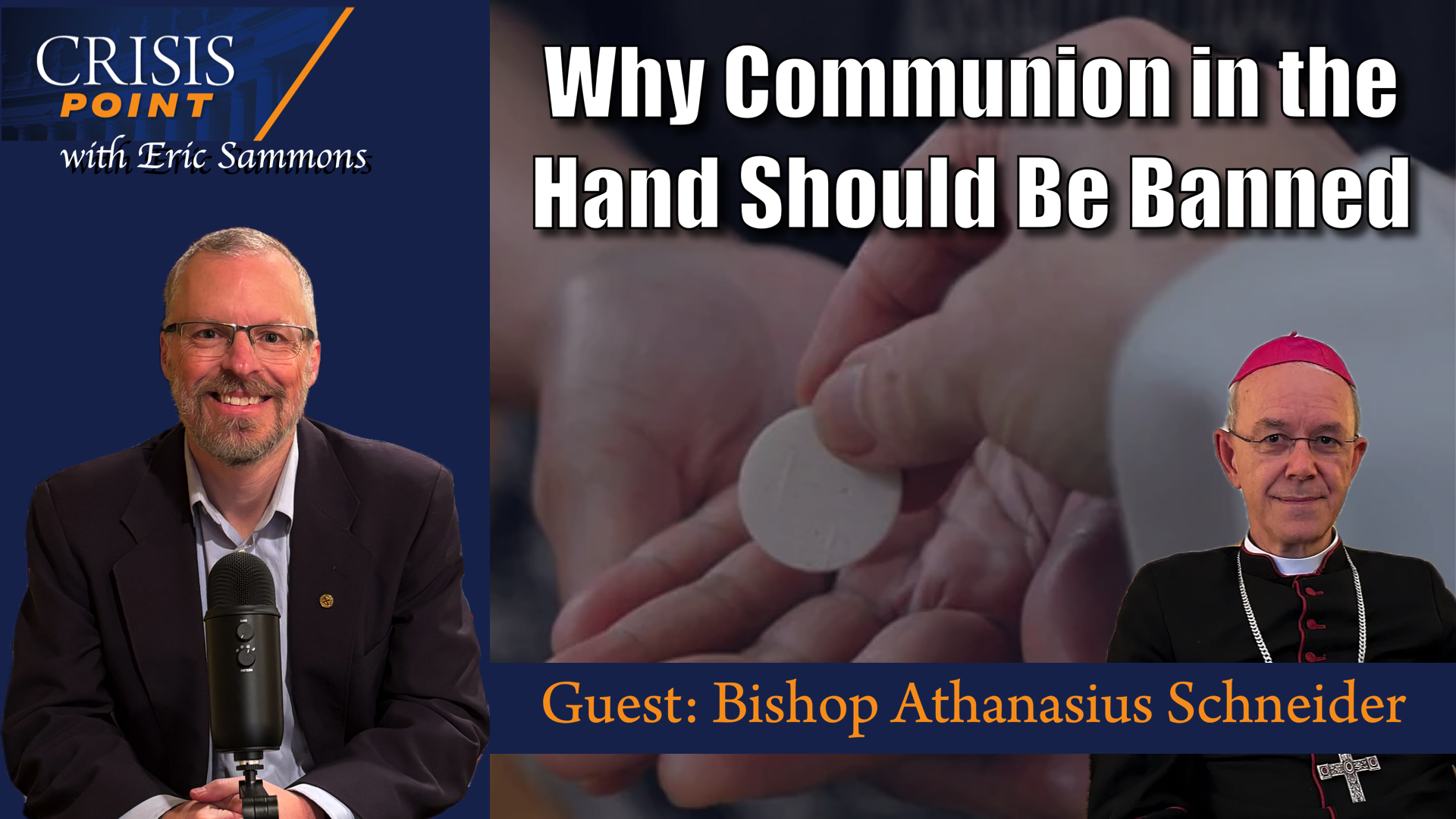
[00:00:14] Speaker B: We're very honored to have Bishop Athanasius Schneider on the podcast today. We're going to be talking about his book, crusade of Eucharistic reparation manual, which is a beautiful little book that basically talks about the crusade eucharistic reparation, which we will be describing in today's podcast, as well as reparation in general.
So welcome to the program, your excellency.
[00:00:36] Speaker A: Thank you. God bless you. Thank you.
[00:00:40] Speaker B: I want to first talk about just the crisis in the church today, because obviously if there's a need to do reparation, then that means there's something to do reparation for.
And so I want to just ask you just on a high level, what would you say is kind of the root cause or the fundamental reason for the crisis in the church today? How would you describe it?
[00:01:05] Speaker A: I would describe that man has put himself in the center and in the place of Jesus Christ.
Jesus Christ was put at the corner and the sight at all levels.
The incarnated truth, the only truth, the only Savior, the incarnated God present real in the Holy Eucharist, in the tabernacle was put in the side removed. And the chair of the priest of man is in the center in the churches and in a circle round human beings.
And Christ can be in the corner.
And this is only visible already. And then the horrible mass desecrations, irreverences towards the Holy Host, the consecrated host, which is the infinite majesty of our God.
The Holy Host is not something.
It's not something.
It is the incarnated God in his infinite majesty and humility, only veiled in the species of bread and wine.
And he is horribly outrage in the Church, trampled by the feet, not by the enemies, by his own children, since 60 years, since the communion in hand was introduced.
And the angel of Fatima in 1916.
Made this affirmation which is so moving and in some way shocking in 1916, where the church was all in order, the liturgy, the veneration of the Blessed Sacrament, the angel made this affirmation to the children when he showed them the Holy Host, from which were dropping drops of blood of Christ in the chalice. And he said, console your God here in the Eucharist, who is so horribly outraged.
This horribly, he said the angel horribly in 1916.
It was prophetic.
It is occurring now.
And therefore I consider the necessity, the urgency to do reparation first, because of the horrible outages, irreverencies, sacrileges and so on of the Blessed Sacrament of our Eucharistic God as Saint John, Saint Peter Julian Amar coined this expression, our Eucharistic God.
And this is serious. We must weep.
We must do reparation.
The first urgency of the Eucharistic.
The second reparation for the relativization of Christ, the truth.
He is put in prison in the Church through spread from high ranking clergy, even partly in the Vatican. Promoting relativism in doctrine, in morals, promoting relativism of religions.
This is an attack, an outrage of Christ, the truth, the incarnated truth, the unique Savior, the unique way under the pretext of dialogue and so on this only pretext.
And this is the second, I think and the third.
The horrible non hurt in churches in human history.
Global worldwide genocide of our unborn co citizens.
The unborn children in the womb of their mothers.
The incredible unspeakable genocide of I say our unborn con citizens.
They are citizens already because they have a personality, they have a soul.
From the conception, the unborn children.
And this is their blood is flooding in streams all over the world in such a way that I think was in such an extent never in humanity.
And this must be also expiated, atoned, made reparation. This comes to my mind these three main horrible crimes against God because Saint Teresa, Mother Teresa of Calcutta once said did the most weak and defenseless beings here on earth is our Lord in the Holy Host and the unborn child.
And these are the greatest crimes.
And so yeah, I.
[00:07:35] Speaker B: One of the things you mentioned was communion in the hand.
And of course communion in the hand is allowed by church officials. People who defend it will say it was practiced in the early church. But I know you've written a book about this in the past and you've come out very strongly against communion in the hand. Could you explain practically why communion in the hand is such a crisis and causes such problems for the Church and leads to indifference towards the Holy Eucharist or even sacrilege against the Holy Eucharist.
[00:08:11] Speaker A: First, I would like to dispel this fake and myth about the so called communion in hand in the. In the old Church. This is a fake.
We must finish with this fake.
Why it is a fake?
Because first, it was done substantially different, the old way and the current first, and it was not universal. Second, we have no testimonies of universal practices. We have from some Syria, North Africa, but not from Rome itself, for example, in the first centuries.
And so in these old forms, it was received with the right hand, not with the left as today. It is such a.
How do you say, a Wrong symbolism with the left hand to receive the holiest of all with your left.
Horrible. It was unthinkable for the old church, which was so keen to symbolism the right hand of the right.
And so it was received, contrary to today, in the right hand.
And then the people were not allowed to touch the Holy Host with their fingers, no, only with the mouth.
So it was in a kind of communion on the mouth, because the priest placed the Holy Ghost in the palm of the right hand.
And then the communicant had to bow down with his head, bow down and take directly with his mouth the Holy Host immediately, directly, without touching with the fingers, and then purifying the palm of the hand, so that no fragment will be lost, you see, at this such end, then the ladies had to put a white dominicale corporale sheet, and not with their bare hands, for example, and also bow down and with their mouth.
So, and it was irreverent. And it was the communion in even in the first century was very rare.
It was rare only some times during the year. So that St. Ambrose, for example, in the fourth century, already admonishes his faithful and to receive more frequently Holy Communion, because he says, why you receive communion only a few times during the year?
You see, as the Oriental does so in Orient, already in the first century, the people prepare themselves with fasting and so on, and received not so frequently and so on. And therefore, when you do something not so frequently, of course it's picological, you have more attention and preparation.
And then?
And then, even though the Church noticed that this form was not sure enough, because could fall down or so, and it happened. And so the Church spontaneously, in the east and in the west, it was a spontaneous move by the Holy Spirit, without doubt, to a deeper reverence, to deeper signs and guarantees, I stress guarantees of sureness, of care.
So that the Church said, why we have to place on the palm of the mouth, when we can do directly in the mouth too simply, it is evident to take more, to be more careful and safety.
And this the Church did since then, since at least from the seventh century, at least, I say, at eight maximum, there were no more communion in H. And even we have local senates in Galia in.
In Spain, in the 8th century or 9th maximum, with the threat of excommunication with anathema, to when someone dares to receive communion in the hand.
So when the Church threatens with anathema, then it's very serious.
And so, therefore, when it was done in the 8th or 9th century, such synods, therefore the practice should have stopped at least a considerable time before, because this were abused and so on. And now the current practice is not that of the ancient church, it is that of Calvin, of the Calvinists, even not of Martin Luther.
And therefore this is the fake, this is the.
How do you say, the disinformation and manipulation which the clergy invented during the Council and after the council until our days. And many of them probably simply ignorant or some know this, but tactically ignore it for manipulation reasons.
And so this form today with the left hand, horrible was my left hand. And then to take the Holy Host with your two fingers and put yourself in the mouth. This gesture is humanly seeing, a self service gesture.
So you give yourself the food and not you receive, of course, you deposit it in in your hand, but then you take yourself. This gesture is so common in take your food, your common food, which we do in your. In our houses daily. We take something with our two fingers and we put in in our mouth. This is from the point of view of symbolic gesture, completely secular, common food taking and nothing sacred.
What a difference. And I repeat this invented Calvin.
And so we have to. When we are, when we are honest intellectually, we have to say honestly, our current form and gesture of the current so called communion at hand is the Calvinistic communion, not that of the of the old church at all. This would be honest because it is the fact.
And so in. Nevertheless, this caused and is causing a huge message loss of the fragments which are stick on the two fingers. Often not even people are not aware, but there are particles in the palm of the hand or between the priest falling particles or.
And this is a fact, and the Council of Trent declared as a dogma of faith that the Lord is present truly even in the smallest part, even in the smallest part of the consecrated host.
As long as it can be seen with your eyes. Of course we have not to take microscope and so on. But as long as it is seen with your eyes, it is a part, even the smallest. But this is a part of the bread and this is the Lord is fully there present.
And so and now they are spreading a new doctrine which is basically heretic staying priest. When there is a small fragment of the Holy Host, they say even we see it, they say, no, it's not more Christ there because it's not more bread, it is bread because it is the substance of bread changed. And it is still bread the same. When you have a small fragment of gold, let us say even the smallest, no one will deny this is gold.
Everyone will Will. Will be agreeing with you. Even the smallest part, you can see still a little bit this gold.
More.
It's gold and the same.
[00:17:27] Speaker B: We would still keep it.
We would still keep it. If it's gold, we wouldn't throw it out.
[00:17:33] Speaker A: Exactly, exactly. And in this small part of fragment which we see on the pattern or on the hands and falling on the ground, it is the Lord and is trampled. And therefore the. The angel of Fatima prophetically said, console your Lord who is so horribly, horribly outraged, trampled by the feet. And then this is the one.
And the other very dangerous consequence is that the.
The stealing of the consecrated host is growing all over the world. It's a network of stealing consecrated host for sacrilegious aims and magic and so on.
This is also a fact, and therefore it is so evident. I think this is the deepest wound in the Church, the communion in hand, the Calvinistic one, which we have not the old. The Church must stop as soon as possible. We cannot continue to dishonor our Lord, the. The. The most Holy in such a horrible way, in such a careless way, in such a superficial way, in such a minimalistic way, in such a common food style.
No, we cannot continue. We must. This would be the first which a Pope should do to protect the Lord, even when he will be persecuted.
We must take this into account for our Lord.
[00:19:16] Speaker B: Now this really touches on, I mean, obviously the most horrible thing about communion in hand is the potential, the likelihood, even the reality that particles will fall, be trampled upon. That is horrible. But also it touches on the symbolic nature of the liturgy and the actions, the liturgical actions that the priest take, that even we as laity take when we're receiving. And so we're talking about communion in the hand, we're talking about whilst receiving, while standing, all the things that often bring up in the debate between the new Mass and the old Mass.
And can you talk about how the symbology, you know, the symbolic nature of the Mass leads to a deeper faith in the Holy Eucharist? And I wonder if it's just like.
Because of the fact that the new Mass has left off a lot of that, that allowed for a growing acceptance of things like communion in the hand, because you don't have as deep of belief in the Eucharist because I. So I just want you address kind of like the. The sim. Symbology of like the. The old Mass versus the new Mass and how it leads us to a deeper appreciation of. Of the. The Holy Eucharist.
[00:20:31] Speaker A: Yes, it is a law of common human psychology.
It is a law.
It requires God created us so that we have, we are united.
Our gestures are inseparably influencing our interior attitudes. This is a law of creation in all religions. You can see it.
And they sometimes give us more moving examples of exterior gestures of veneration.
Even pagans or Buddhists or Muslims, when they are deeply prostrating, deeply gestures of reverence and so on.
And the more we that only true religion, where we have the incarnated God.
Here in the Eucharist, we would we should do the maximum what we can expressing our deeper faith, which in our soul it is, requires necessarily the faith exterior expression of faith, necessarily. If this is lacking by time, it has an a back influence on your faith and your attitude that it becomes weak. And by time you then consider it like a common fruit or just a symbol. And this is the case simply the best statistic made in the last years in the States, in Europe. And so by Catholics who already from two generations do only communion in hand. And the majority of them simply without nothing thinking spontaneously say yes, this is a symbol because you are treating it in such a common way. Something which is.
Then it is a symbol when it is really inexpressive, ineffable majesty of God, you cannot treat it. So you must kneel. You must do the maximum of reverence and safety and even humility, like a child, open your mouth.
Like the sinners who repented sinners before God in the temple. The sinner, he was kneeling and striking his breast and so on. But the Pharisee, he was standing in front and saying, this is a difference.
And because the people who are kneeling communion are accused by some clergy, you are Pharisees. It's to the contrary, because the Pharisees did not kneel.
Who knelt, who knelt the repented sinner behind in the temple who knelt and who was striking his breast.
This is true humility.
And so it is a law of human nature. We have to. And the Church observed it for 2,000 years.
And now after the Council, all the majority of these symbols disappeared. And therefore the faith became so weak in the Eucharist and ambiguous.
[00:24:13] Speaker B: So yeah, now one of the things that can happen for lay people, I think, and I see this a lot in the work I do, that we see this crisis, we see the lack of reverence for the Blessed Sacrament, we see the sacrilege, the indifference, everything like that.
We see what's going. We see a lot of church officials who aren't really. Don't seem to really care about it, maybe even foster the indifference Some. And we are, we get angry, maybe we get upset, but we, we feel like we can do nothing about it. And we, we just want to point fingers at the bishops or at priests, whatever. But what I, I appreciate is what you're saying is there is something we can do about it and that's reparation. But I honestly think most of us lay people, we never hear the term reparation in homilies or anything at all. So could you first just explain what reparation is? Because I do think there are people listening who don't even know what reparation is.
[00:25:11] Speaker A: Well, the greatest act of reparation is the death of our Lord, his saving death on the cross. This is the greatest act of reparation.
He offered to God act of love, his total surrender and devotion as a substitution for the lacks and the what human humanity committed against the love of God, the honor of God.
And so he like, he put this like, you know, in a way, in a balance, he counterbalanced it this with his act of love.
And in the name of the sins, he made the contrary, the act of love, of reverence, of obedience in such a way which has an infinite value because Jesus Christ was a divine person, he had the divine personality. And therefore his acts in his humanity, of course were of infinite value, his act of reparation on the cross.
And so, and we must imitate Christ and unite ourselves with Christ our head, we are the members.
And St. Paul said these words I add, or I would like to add to the acts of reparation of Christ what is lacking for his mystical body, with my sufferings, with my prayers. This is a definition of reparation which the Holy Spirit, the Holy Scripture is giving us. St. Paul is it's inspired word of God and I repeat the example of our Lord and who is loving the Lord desires to be united with his feelings. And his feelings on the cross were feelings of reparation for us, for my own sins, first for our and then for the entire humanity and then for all the horrible sins which humanity ever committed and will commit, already expiated, atoned by the blood of Christ.
And so we have a beautiful document of the magisterium of the Church of Pius xi, an encyclical about reparation. What does mean reparation atonement? It is called miserentissimus Redemptor 1928. I will recommend to read it. It is available Internet and in Google simply Pius XXI encyclical movies 1928 there is the entire church doctrine on the reparation. But I made a small synthesis. And also the message of Fatima is essentially a message of reparation and atonement as. As the angel already asked to do consolation reparation, then Our lady explicitly asked the children to offer acts of reparation for the sins of the world.
The children and the St. Francisco and Jacinta in their life, they are really moving examples for U.S. adult persons. How children made acts of sacrifices and other small sacrifices and even greater sacrifices when they accepted their illness and pains, when they were sick and then their death.
Only they repeated so often. Francisco and Jacinta I. I'm doing it. I want to do it, to suffer it, to console the Lord who is so much offended.
What an example for our day of acts of reparation, these holy children.
[00:29:35] Speaker B: So, I mean, it's something, I think that's difficult for us to understand the modern world and our kind of prostitized view of the faith. To be honest, this idea that this other person, somebody we don't even know, commits some sin and then I can do something that somehow I. I tell me, by the way, if I'm saying anything theologically incorrect, please correct me. But in some way repairs the damage, so to speak, for what that other person did. Is that a kind of very basic way of, kind of looking that. That my sacrifice or whatever I might do, prayers might in some way repair some of the damage done by the sin done by somebody else? Is that. Is that correct?
[00:30:18] Speaker A: Yes. Because the deepest reason is that we are connected as a living body.
We are one body, only one body, mystical body. And St. Paul explained it, when one member is suffering, all the entire body is feeling the suffering.
And so suffering also in the sense of sinning. So we are feeling the certain impact the sins of the members of the Church for the entire body.
And therefore St. Paul calls us to, in some way to substitute with good acts, with love these failings of the other parts of the Mystical Body.
And therefore we must consider it as especially in the Church, that we are one body. But we can also offer to the Lord through Christ, even reparation for non Christians for the grave sins in the world, for abortion and others through united with Christ with our heart and offerings through the hands of Our Lady. She is the co Redeemer or co Suffering with Christ under the cross. The greatest example for us as a human creature, which participated in the reparation of Christ most closely as a mother and helps us also to do it. To do it.
[00:31:54] Speaker B: So is all reparation that we do Is it true then to say that any reparation we do, it's united to the one reparation of Christ on the cross. Is that proper to say that?
[00:32:07] Speaker A: Of course, it cannot be other.
He's the only source of reparation. What we can do, we can only do reparation in deepest unity of Christ, in Him, with him, through him, as the Holy Mass says. And especially during the Holy Mass when the sacrifice of cross is again present at the altar, we are participating. This is the most active participation when we really active. This is active when we kneeling basically under the cross spiritually and offering with Our lady to the to the Heavenly Father, this reparation act of love of His Son and putting our small acts like the drop of water in the chalice, united with his great act of reparation.
And then when we receive especially Holy Communion, we have the Spirit of Christ because this is his immolated body.
Immolated body. We receive in Holy Communion because glorified, wounded still.
And so we have this in our body. And this helps us to grow in the Spirit, especially acts of holy hours of adoration before the Blessed Sacrament. It helps us to grow in the Spirit of Christ in his loving reparation.
[00:33:37] Speaker B: Now I want to ask you specifically then about the Crusade for Eucharistic reparation. I know we. We started a few years ago, I believe 1 Peter 5, our sister publication has published a lot about it and kind of been the. The where everything is. It started but this manual then goes through it. Could you explain specifically what.
What's the intention of the Crusade and what is being asked of people who participate in the Crusade?
[00:34:02] Speaker A: Yes, I have to say it was partly your suggestion also and people and I gladly accepted it to do because as we now spoke of the urgency of Eucharistic reparation because of these horrible or outrages of the Lord, the Eucharistic Lord and the necessity. The best moments and acts of preparation is during the Mass and during the holy hours of the Blessed Sacrament before the tabernacle or the Blessed Sacrament in the in the monstrance.
And therefore this booklet and book was I made with the help of yourself and others.
It was a common work to give some concrete tools and prayers that people can use traditional. We made different prayers from the treasure of the prayers of the Holy Church and so that people who could concretely use prayers of reparation and then spread it to others.
[00:35:15] Speaker B: Right. And if I if I remember correctly, then what's being asked is that you can basically the intentions I'LL just read here for people. I want to link to the book by the way in the show notes for everybody watching. Also to 1 Peter 5 where it talks about this but says to make reparation to God for sins committed against the Blessed Sacrament, especially due to the practice of the communion in the hand. And the second intention is to rescind the provisions of tradition custodes and remove all restriction on the celebration of the traditional Roman Rite of Mass in the Church.
And then what it's asking for is three required devotions are spend at least one hour in eucharistic adoration per month offered in reparation for the sins committed against the Blessed Sacrament. Pray at least once per month for the the prayer of the Crusade reparation for the Eucharistic heart of Jesus which is in the book and then share this crusade with others. And you there's some other optional things. So it's, it's now you know, it's something I think any Catholic can do. You don't have to. It's not asking for something that you, that people physically can't do. If you can get to holy hour at least once a month and you and say the prayers and everything, you can do it. And, and so what is your hope then for this crusade that obviously one of the main hopes is that the communion in hand stops. But, but kind of what is your hope for Catholics to embrace this crusade and how it can, how it can really help the Church?
[00:36:38] Speaker A: My hope is that it grows more and reaches all over the world. Maybe it could be a really a net spread all over the world.
Even simple people, children we can invite because their prayer is very precious before God.
And the cloistered nuns for example invite also to participate to spread more they that we are really we encircle the entire world with this net of eucharistic reparation.
And the Lord said pray and it will given to you.
So we pray that the restrictions of the traditional Mass will end.
And they will end. God knows. But we must pray and hope and that this restriction on traditional Latin Mass should end. I am 100% convinced this is the will of God.
And when we pray for this, this is according to the will of God, a prayer. And when we do prayers according to the will of God evidently as in this case to free the traditional Latin Mass it will be given in his in its time. God knows.
[00:38:02] Speaker B: Yes. I'm hoping it happens sooner rather than later. But that's God's, you know we our reparations hopefully will bring that about as well. So. Well, I. I just want to. I want to wrap it up here, but thank you, first of all, your Excellency, for all your work.
I know that you. I'll. Like I said, I'll link to the. The website for the.
The. The first of all, the encyclical you mentioned by Pius 11th. I'll link to that. So people can find that easily. 1 Peter 5, which talks about the reparation and. And the book also. I know you have a website with all. With a lot of your teachings and with interviews and things like that. It's a. Oh, boy. I'm. Do you remember the website address? Because I'll link to it as well. I think it's like a Mago day, isn't it, or something like that?
[00:38:44] Speaker A: Gloria Day Convert.I. oh, yes, yes.
[00:38:52] Speaker B: I. I mean, I know the guy who makes it and I'm involved with that, so I shouldn't remember that. But yeah, I'll put the link to that as well. The glory day. And people can find a lot of your teachings. You do a great service. I think it's once a month you have an interview with Christopher Wint. He asks you questions that just come in, and I think it's a great thing because a lot of the questions that just your average faithful Catholic has, in this time of confusion, you clear them up very, very directly. So I really do appreciate that.
[00:39:20] Speaker A: Thank you.
[00:39:22] Speaker B: Okay. Would it be possible. I think this is. Okay. It would be possible if you just gave a blessing to. To everybody who's kind of watching this and listening to it.
[00:39:30] Speaker A: Yes.
[00:39:31] Speaker B: Thank you.
[00:39:32] Speaker A: Dominus vobiscom.
Spirit Benedicta de omnipotentis. Patrice. Ed. Willie.
Praised be Jesus Christ, now and forever.
[00:39:52] Speaker B: Thank you very much, your excellency.
Okay, everybody, until next time. God love you.
It.
 Bishop Athanasius Schneider joins us to talk about the sources of today's widespread indifference and disbelief toward the Eucharist, and what we can do to combat it.